Attraction · Jaipur
Amber Fort
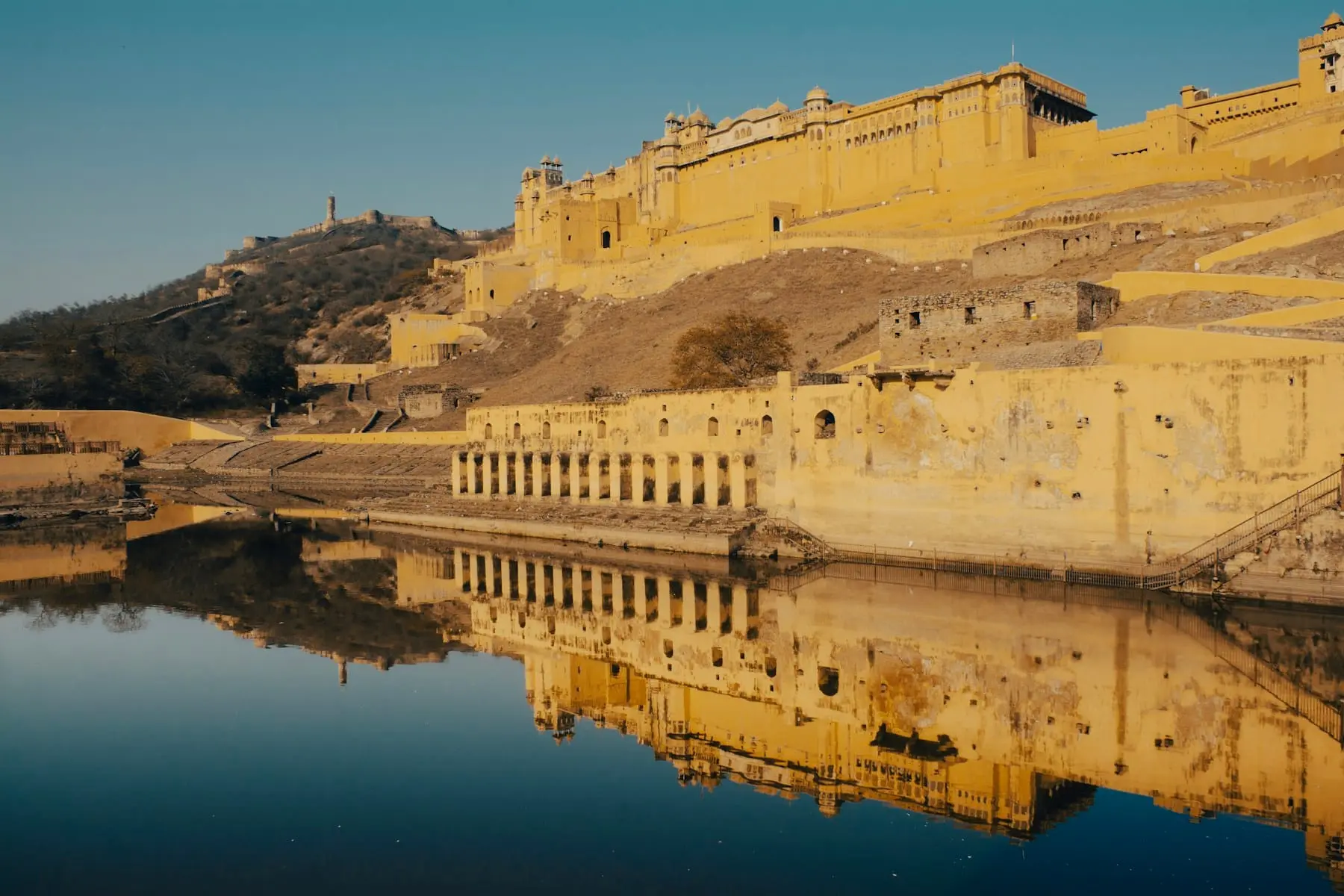
Amber Fort — also spelled Amer — is a fort-palace in the hills about 11 km from Jaipur, rising above Maota Lake. It was the stronghold of the Kachhwaha rulers until they moved their capital to Jaipur in 1727, and it is one of the six forts that make up the Hill Forts of Rajasthan World Heritage Site.
History
Raja Man Singh I began the palace in 1592, and it was completed under Mirza Raja Jai Singh. UNESCO highlights Amber as a key 17th-century stage in the development of a shared Rajput–Mughal court style, associated with Mirza Raja Jai Singh I. The court stayed here until Sawai Jai Singh II founded Jaipur on the plain below in 1727, prompted by a growing population and a shortage of water.
What to see
Built of red sandstone and white marble, the palace is arranged around courtyards that climb the hillside, each more private than the last. Part of the appeal is the contrast between the fortified exterior and the richly decorated rooms inside, with their carving, inlaid stone and mirror work.
- Diwan-i-Aam — the hall of public audience, its roof carried on rows of columns.
- Ganesh Pol — the painted gateway that leads to the rulers' private apartments.
- Sheesh Mahal — a hall whose walls and ceilings are inlaid with mirror work.
- The ramparts — views down to Maota Lake and along the fortified walls on the surrounding hills.
Planning your visit
Allow two to three hours to see the main courtyards without rushing. The fort gets busier from mid-morning, so an early start makes for a cooler, quieter visit. Conservation work continues at the site — UNESCO's 2025 conservation report notes ongoing works and efforts to revive Amber's historic water system — so parts of the complex may be under repair when you visit.
In the evening, a sound and light show staged with the fort as its backdrop tells the story of Amber and the Kachhwaha dynasty. Check current show times locally.
Nearby in Amer
- Jaigarh Fort — built by Sawai Jai Singh II in the early 18th century, on the hills beside Amber.
- Anokhi Museum of Hand Printing — about ten minutes' walk through Amer's lanes, in a restored haveli, showing the region's block-printing tradition.
- Jagat Shiromani Temple — a temple in Amer dedicated to Krishna and Vishnu, said to have been built around 1599–1608 by Queen Kanakwati.
Before you go
- Wear comfortable shoes: the approach and the courtyards involve ramps, steps and uneven stone.
- Combine the visit with Jaigarh Fort, or with Nahargarh Fort for views back over Jaipur.
About this page
- Published
- Last updated
- Facts last checked
Sources
- Jaipur — Rajasthan Tourism (Department of Tourism, Government of Rajasthan) (accessed 9 October 2026)
- Hill Forts of Rajasthan — UNESCO World Heritage Centre (accessed 9 October 2026)
- State of Conservation 2025: Hill Forts of Rajasthan — UNESCO World Heritage Centre (accessed 9 October 2026)
- About us — Department of Archaeology and Museums, Government of Rajasthan (accessed 9 October 2026)
Timings, fees and transport details change. Always confirm with official sources before you travel.